Above picture: A. Frame from a motion-activated infrared camera of a House Mouse attacking an adult male Wandering Albatross, inset close-up of the scalp wound. B. An adult male Wandering Albatross brooding its chick with a severe wound to the elbow joint of its wing. C. An adult male brooding its chick, with a wound on its right tibiotarsal joint, bleeding onto the bird’s rump. D. A minor wound was detected on the right elbow of an adult male Wandering Albatross (from the publication)
Michelle Risi (Marine Apex Predator Research Unit, Nelson Mandela University, Gqeberha, South Africa) and colleagues have published in the journal Biological Conservation on their observations of introduced House Mice attacking and killing adult Wandering Albatrosses Diomedea exulans (Vulnerable) on South Africa’s sub-Antarctic Marion Island. The publication includes three short videos as electronic supplementary material depicting mouse attacks.
The paper’s abstract follows:
“Invasive rodents severely impact native species, especially on oceanic islands. House mice Mus musculus are known predators of seabird chicks, and there is growing concern about their attacks on adult birds. On sub-Antarctic Marion Island, the single largest breeding site for wandering albatrosses Diomedea exulans, invasive mice, the sole introduced mammal, pose an escalating threat to this Vulnerable species. We report the first direct evidence of mice attacking adult wandering albatrosses, and record mouse attacks on adult wandering albatrosses beyond the localised incidents reported in 2023. Of 2,979 wandering albatross nests counted island-wide in January 2024, 2,295 remained active in April, with 1,102 attended by adults brooding or guarding chicks. Of these, 11 adults (1%) exhibited mouse-inflicted wounds (including a scalp injury, as well as the more common wing joint wounds), and two fresh adult carcasses were discovered. Injured adults and carcasses were distributed across all wandering albatross breeding colonies. Wounds predominantly affected males (10 of 11); one adult succumbed to its injuries within six weeks. The 11 nests with injured adults had a 45% breeding success rate, below the island-wide average of 61%. At Cape Davis, where mice were first recorded attacking adults in 2023, breeding success was just 28%. This expansion in attack range and severity underscores the urgent need to eradicate mice from Marion Island to conserve wandering albatrosses and other threatened biota.”
The paper’s findings confirm the absolute necessity for the Saving Marion Island’s Seabirds: The Mouse-Free Marion (MFM) Project to continue to work towards its ultimate goal; ridding Marion Island of its albatross- and petrel-killing mice.
With thanks to Michelle Risi.
Reference:
Risi, M.M., Jones, C.W., Connan, M., Gill, R., Stephen, V., Cunningham, S.J. &·Ryan, P.G. 2025. Escalating threats: house mouse attacks on adult wandering albatrosses spread across Marion Island. Biological Invasions 27. 149. doi.org/10.1007/s10530-025-03610-8.
John Cooper, News Correspondent, Mouse-Free Marion Project, 12 June 2025
*****************************************************************************
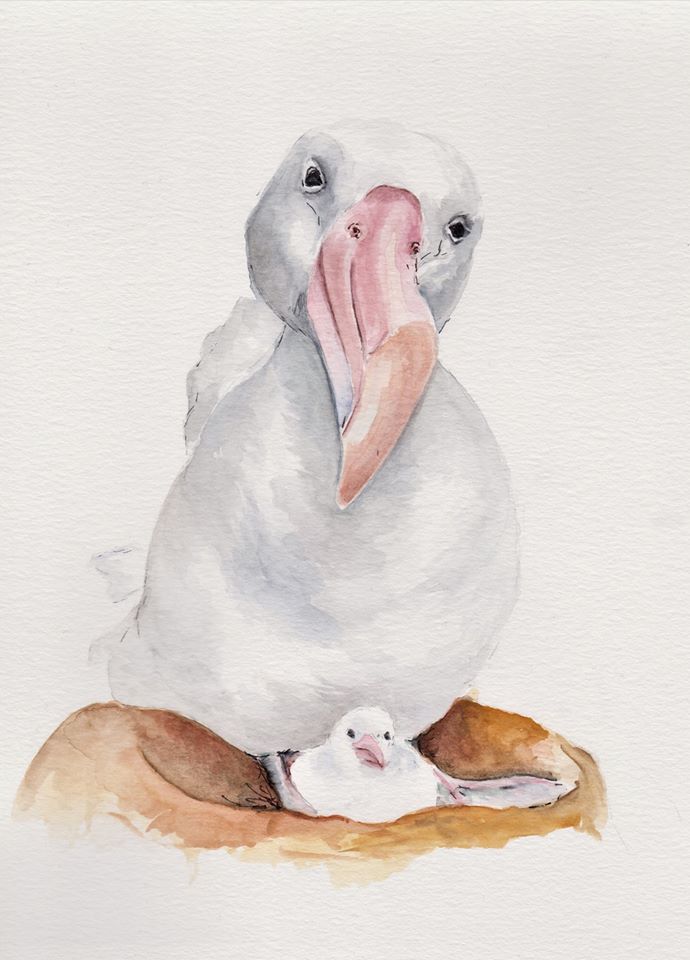
A Wandering Albatross stands over its young chick on Marion Island, artwork by Lea Finke of Artists & Biologists Unite for Nature (ABUN) for World Albatross Day 2020; after a photograph by Michelle Risi
The Saving Marion Island’s Seabirds: The Mouse-Free Marion (MFM) Project is a registered non-profit company (No. 2020/922433/08) in South Africa, established to eradicate the invasive albatross-killing mice on Marion Island in the Southern Ocean. The project was initiated by BirdLife South Africa and the South African Department of Forestry, Fisheries and the Environment. Upon successful completion, the project will restore the critical breeding habitat of over two million seabirds, many globally threatened, and improve the island’s resilience to a warming climate. For more information or to support the project please visit mousefreemarion.org