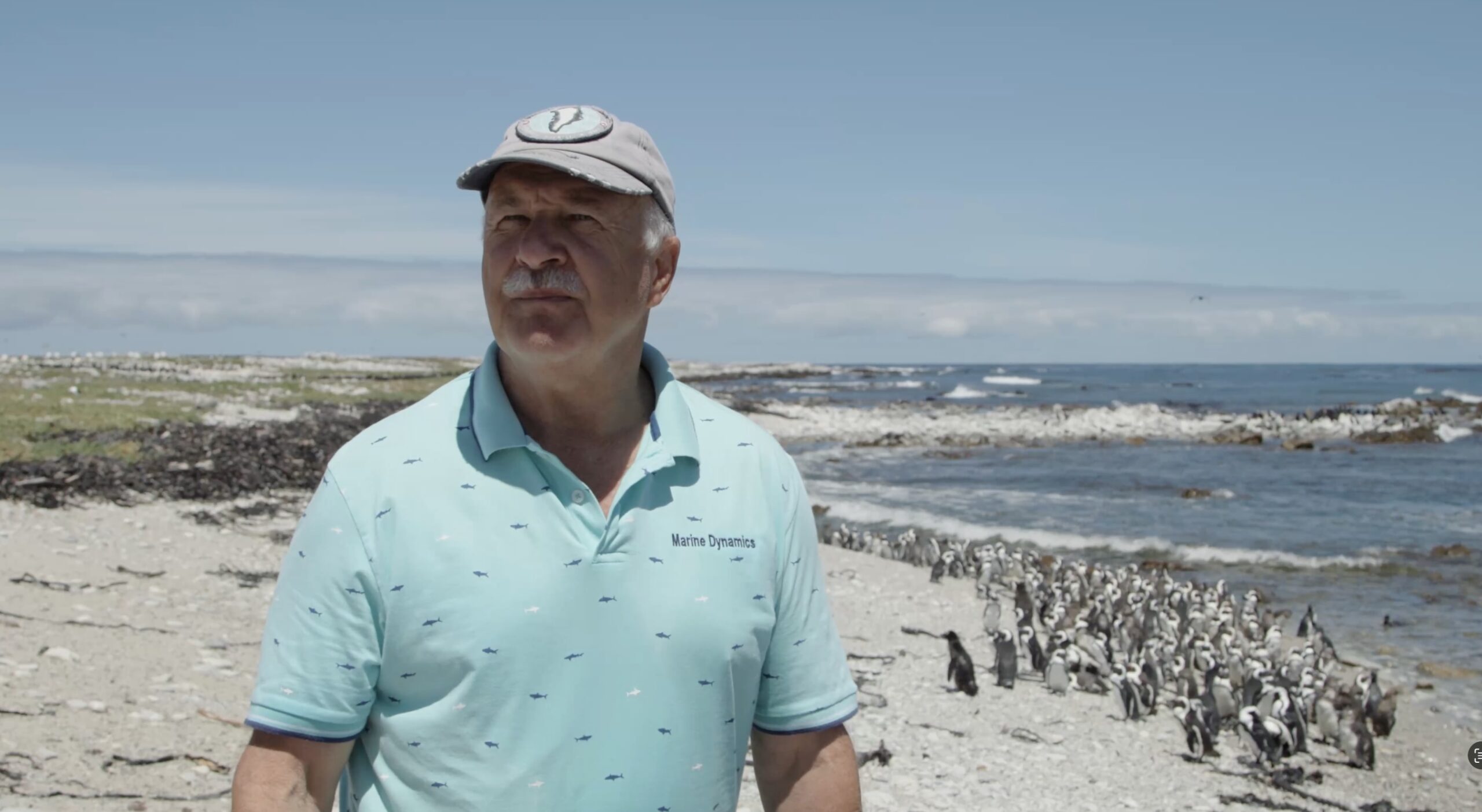
Wilfred Chivell in front of African Penguins resting along the shoreline on Dyer Island
The Dyer Island Conservation Trust is a South African NGO based in the coastal village of Gansbaai close to the southern tip of the continent. Dyer Island, with its population of Critically Endangered African Penguins Spheniscus demersus, is visible from the shore. Founded in 2006 by its CEO, Wilfred Chivell, a Gansbaai native, the trust works to conserve Africa’s only penguin by caring for and rehabilitating diseased, displaced, injured, oiled and abandoned seabirds in its African Penguin and Seabird Sanctuary, which it established in 2015. The trust also collects abandoned penguin chicks for hand rearing and releasing back to sea and has installed artificial burrows on Dyer Island to improve breeding success via its “Penguin Penthouse Project”.
Among all its work with South Africa’s coastal seabirds, the trust has sponsored 10 hectares to the Saving Marion Island’s Seabirds: The Mouse-Free Marion (MFM) Project to help the country’s pelagic seabirds, as recorded in the Rockhopper Penguin category on the website’s Honour Roll. Previously, the trust had donated vouchers for two persons on a shark cage diving eco-tour and on a whale-watching eco-tour to the total value of R20 000 to the MFM Project. The tours are run by Marine Dynamics (which operates out of Gansbaai and which Wilfred owns) and were auctioned during the Flock to Marion AGAIN! 2025 voyage.
MFM News got in touch with Wilfred to find out why he decided his trust had supported the MFM Project.

Wilfred soon replied, writing: “Since being invited to be part of the scientific observation team during an annual takeover on Marion Island in 2004, I realised the immense plight of seabirds and the profound impact humans have on them. The experience changed me. Standing amongst those vast colonies, witnessing both their resilience and their vulnerability, I developed a deep respect and genuine love for seabirds. They are extraordinary ocean ambassadors, yet they are increasingly under threat from predation, pollution, climate change, overfishing and habitat disturbance. They need all the protection we can give them.”

Wilfred Chivell on the edge of a Black-browed Albatross Thalassarche melanophris colony on Steeple Jason, Falkland Islands
He continues: “That experience deepened my commitment to marine and seabird conservation and inspired me to visit other remote islands renowned for their birdlife. These have included the sub-Antarctic islands in the Southern Ocean — such as the remote New Zealand sub-Antarctic Islands (Auckland, Campbell, Antipodes, Snares and Bounty groups) — which are internationally recognised for their extraordinary seabird colonies where many species breed and nest in large numbers. I have also travelled to the Falkland Islands, another globally significant destination for seabird diversity, where extensive colonies of albatrosses, petrels and four penguin species thrive in remote island habitats.”
Wilfred concludes by saying that these experiences have reinforced his belief that conservation must move beyond words to action. A belief with which the MFM Project is fully in accord.
The Dyer Island Conservation Trust’s support of the MFM Project is doubly appreciated, given that it needs to raise funds towards its own conservation efforts that are centred on the African Penguin. Saving seabirds together!
Want to sponsor your own hectare? Go to https://mousefreemarion.org/donate/.
With thanks to Christine Wessels, Public Relations Officer, Dyer Island Conservation Trust.
John Cooper, News Correspondent, Mouse-Free Marion Project, 06 March 2026
*********************************************************************************

Near 80 years ago a Vulnerable Wandering Albatross Diomedea exulans sits quietly on its nest on Marion Island, with buildings of the meteorological station in the background in early 1948. Photograph by Officer-in-Charge, Allan Crawford, courtesy of his son, Martin Crawford
The Mouse-Free Marion Project is a registered non-profit company (No. 2020/922433/08) in South Africa, established to eradicate the invasive albatross-killing mice on Marion Island in the Southern Ocean. The project was initiated by BirdLife South Africa and the South African Department of Forestry, Fisheries and the Environment. Upon successful completion, the project will restore the critical breeding habitat of over two million seabirds, many globally threatened, and improve the island’s resilience to a warming climate. For more information or to support the project please visit mousefreemarion.org.