The 1948 flagpole and brass plaque at the entrance to the annexation cave behind Cave Bay, Prince Edward Island. Photograph by David Hedding, December 2013
Unlike Marion Island, its larger neighbour 22 km away, Prince Edward Island is free of introduced House Mice (and any other alien mammal). Anyone (and that includes myself) who has camped there will remember the pleasure of nights undisturbed by the scampering of mice trying to gain access to the tent – and finding no droppings inside the left-out cooking pot the next morning! The island is free of the obvious mouse runways through the vegetation that are a frequent sight on Marion.
The relative abundance (and larger size) of invertebrates, including the tiny spiders that come out to crawl over your legs when seated on a windless day, is a revelation in comparison to its neighbour, which is plagued by the insectivorous mice. The numbers of Lesser Sheathbills that forage for invertebrates among inland mire vegetation and the presence of uneaten grass heads on Prince Edward are also indications of the lack of mice.
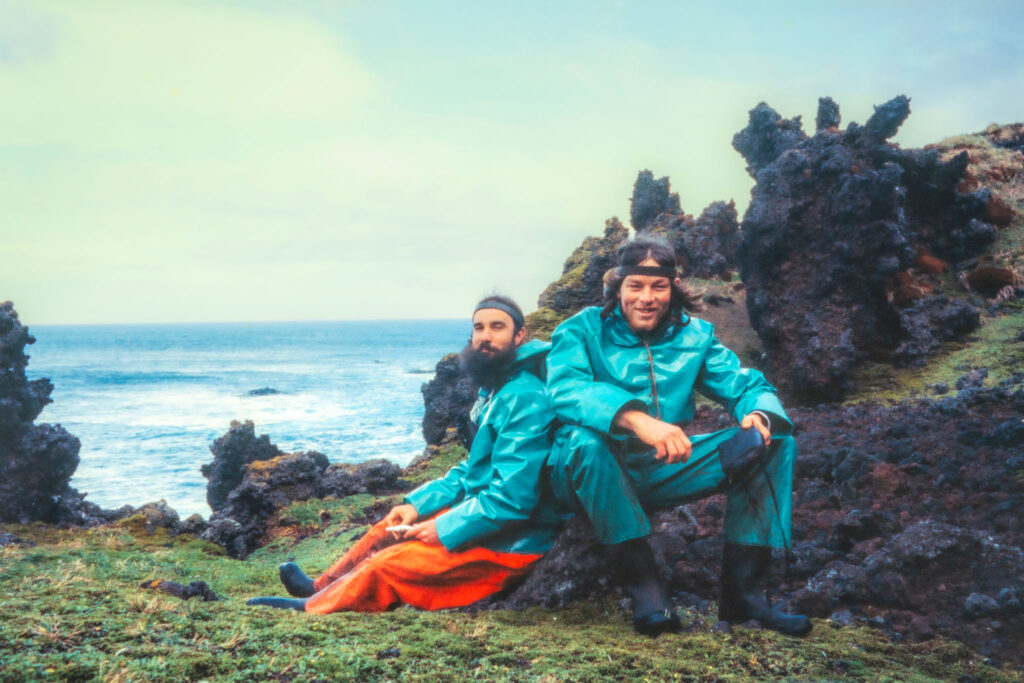
James Gleeson (left) and Lex Hes on Prince Edward Island in 1980
But of course, these anecdotal, although repeated, observations are not completely compelling. Clearer evidence of the absence of mice on Prince Edward Island comes from a research trip made by the late James Gleeson and Lex Hes from 30 May to 5 June 1980. The pair, from the University of Pretoria’s Mammal Research Institute, went to the island from Marion to investigate “the presence or absence of mice in relation to insect fauna”. Unfortunately, mention of their visit is not made in James’ MSc thesis or his published paper on Marion’s mice, nor have I come across a trip report. However, recently I was put in contact with Lex, James’ assistant, who kindly sent photographs of their visit – and answered my questions. Lex, from memory, and we are going back nearly half a century, remembers that they hiked around the island setting baited snap and Sherman live mouse traps (and collecting invertebrates) in different localities, including setting snap traps inside the annexation cave at Cave Bay. He is uncertain quite where traps were set, and how many, but remembers they filled a backpack, so one imagines they had and deployed a fair number. Return visits after baited traps were left out overnight revealed no mice.
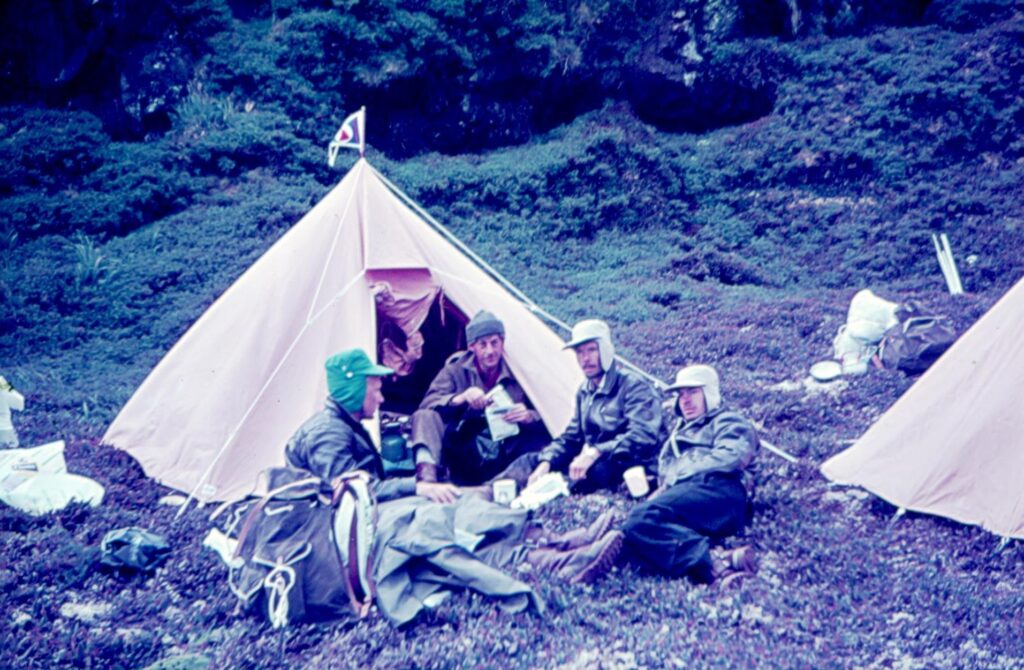
Members of the South African Biological & Geological Expedition camping on Marion Island, where members were bothered by mice, which caused “much damage to clothing and food”. The same tent design was used on Prince Edward Island, photograph by Brian Huntley
The question now arises: when was it first realised that Prince Edward Island was known (or at least thought) to be mouse-free? Here we need to delve into a little history. South Africa annexed the island in January 1948, landing to raise a flag outside the annexation cave behind Cave Bay. For at least a couple of years after that, landings were made from South African Navy frigates, as inscribed on a brass plaque mounted at the cave entrance. But these would all have been short visits of only a few hours with no overnighting. To my knowledge the first persons to stay overnight since the sealing era were the six scientists of the South African Biological & Geological Expedition who camped on Prince Edward from 18-22 March 1965. Brian Huntley, the botanist, wrote in his published diary their belief that they were the first to go ashore in 15 years. Three members revisited the island in 1966 from 28 March to 1 April. I have recently contacted two expedition members, Brian Huntley and the ornithologist, Eduard van Zinderen Bakker Jr, to ask about their visits. Both say they saw no mice or signs thereof on either of their two visits, but neither could recall if they believed Prince Edward to be mouse-free beforehand.
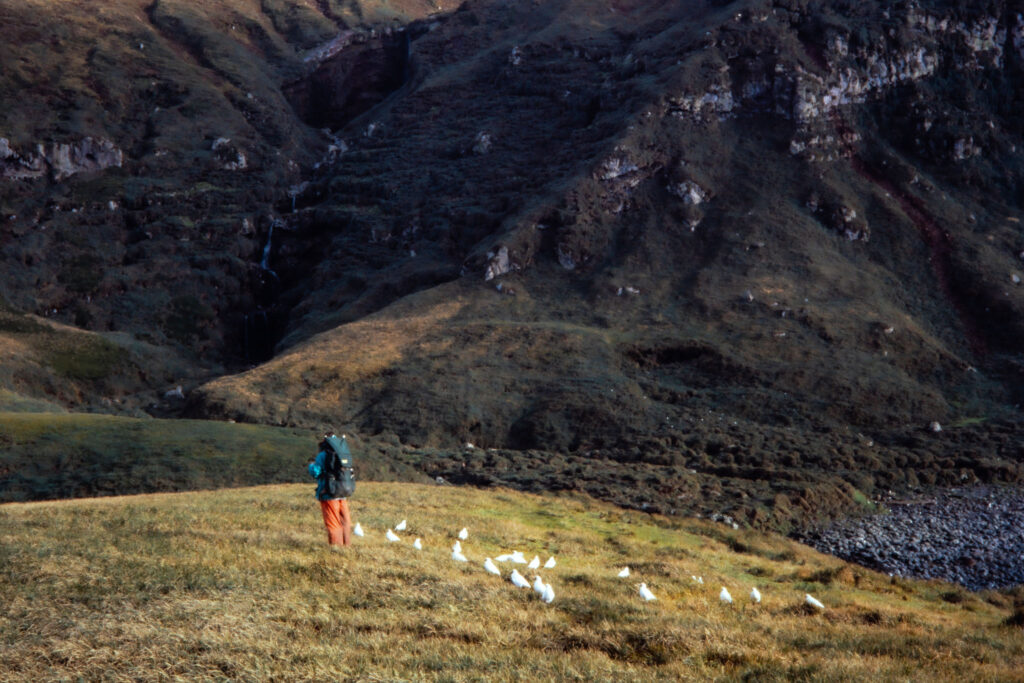
James Gleeson with a flock of inland-foraging Lesser Sheathbills on mouse-free Prince Edward Island in 1980, in stark contrast to mouse-infested Marion Island, photograph by Lex Hes
I have approached several of the scientists who overnighted on the island in the 1970s. All who have replied remember noting the absence of mice. Alan Burger, who overnighted on Prince Edward Island in 1974 and again in 1977 states “As I recall it was common knowledge that there were no mice on [Prince Edward] and we certainly saw no evidence of mice during our stay[s]”. Presumably, the 1970s researchers learnt of the absence of mice as news filtered down from members of the 1965/66 Expedition.
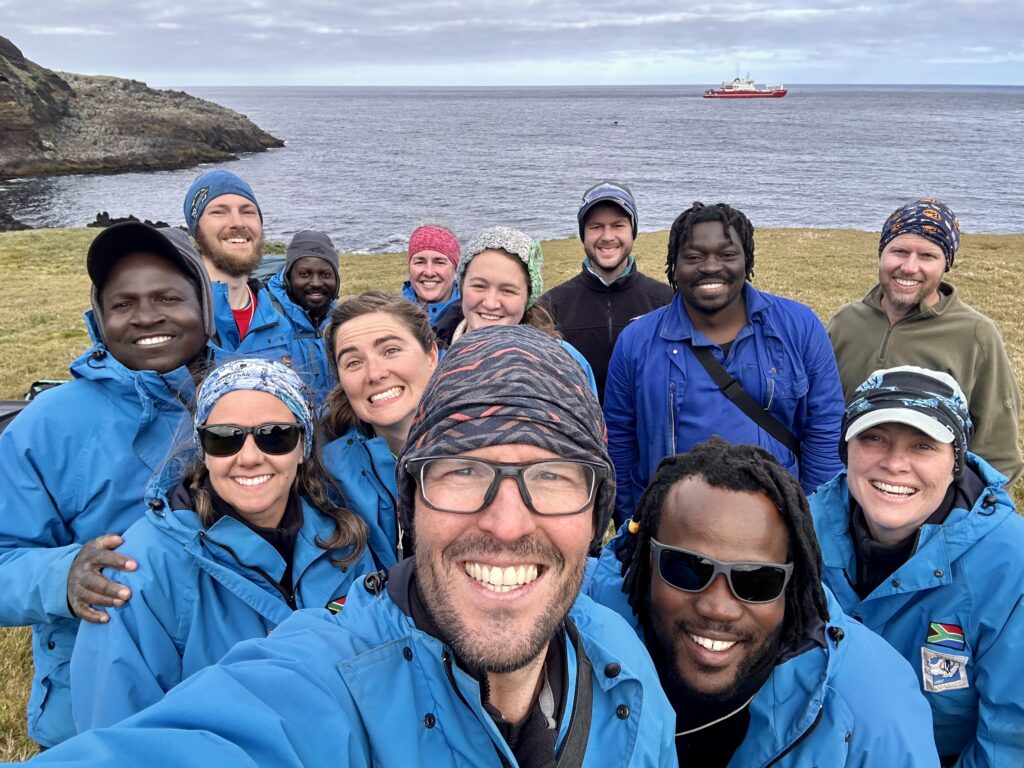
Unbothered by mice. Members of the Prince Edward Island 2023 Expedition members smile for the camera, with the S.A. Agulhas II offshore, photograph by David Hedding
The last overnight visit to Prince Edward Island was in December 2023, when 13 scientists spent six nights ashore. No signs of mice were seen. Like all previous visits in the last two decades, strict biosecurity protocols were followed, so it seems near certain the island remains mouse free.
A minor mystery still remains of who first established that Prince Edward Island had no mice. A question that might never be properly answered, given the passage of time! Nevertheless, a take-home message from all the visitors is how pristine the island is in comparison to mouse-ravaged Marion Island. Restoring Marion to match the biodiversity of Prince Edward is the aim of the Saving Marion Island’s Seabirds: The Mouse-Free Marion (MFM) Project. This is an aim that will be applauded by anyone who has had the privilege of visiting and staying overnight on Prince Edward Island.
With thanks to Mark Anderson, Alan Burger, Brian Huntley, Kevin Hall, Lex Hes and Eduard van Zinderen Bakker Jr.
John Cooper, News Correspondent, Mouse-Free Marion Project, 17 March 2026
******************************************************************
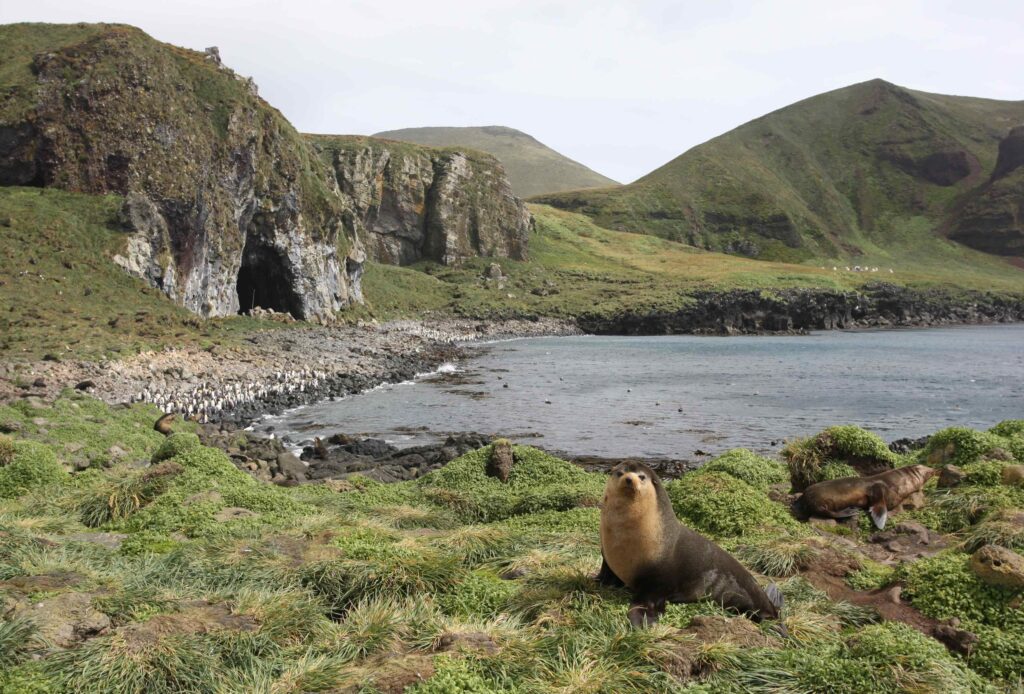
Cave Bay, Prince Edward Island, with the annexation cave and flagpole visible. No mice were found here during the 1980 trapping, photograph by Peter Ryan
The Saving Marion Island’s Seabirds: The Mouse-Free Marion (MFM) Project is a registered non-profit company (No. 2020/922433/08) in South Africa, established to eradicate the invasive albatross-killing mice on Marion Island in the Southern Ocean. The project was initiated by BirdLife South Africa and the South African Department of Forestry, Fisheries and the Environment. Upon successful completion, the project will restore the critical breeding habitat of over two million seabirds, many globally threatened, and improve the island’s resilience to a warming climate. For more information or to support the project please visit mousefreemarion.org.