Above photo: The takeover team suiting up to begin hand-sowing bait across their study site on Marion Island.
Each year, the Department of Forestry, Fisheries and the Environment (DFFE) undertakes a relief voyage to Marion Island, a South African Special Nature Reserve some 2,200 km south-east of Cape Town.
The annual voyage provides the only opportunity for scientific and maintenance staff to travel to the island. The annual over-wintering team is also relieved by a new team during the voyage.
Prior to the 2025 voyage, the Saving Marion Island’s Seabirds: The Mouse-Free Marion (MFM) Project had commissioned a Research Plan to identify research needs that would inform the mouse eradication design and to outline trial methodology. Some of these trials were scheduled for 2025 and the annual relief voyage provided the only opportunity to conduct them.
Accordingly, we set about organising a group to participate in the voyage and conduct the first trials outlined in the Research Plan. Joining the team for the voyage south were the two newly-recruited Field Assistants for the MFM Project – Roelf Daling and Vonica Perold; Josh Kemp, recruited to oversee the trial implementation; Otto Whitehead, Field Assistant/Cinematographer; and Keith Springer, MFM Project Operations Manager.
After completing the various voyage formalities, we boarded South Africa’s modern polar resupply and research ship, the RV S.A. Agulhas II late on 17 April and departed Cape Town the following afternoon. Steaming south east in moderate sea conditions, we reached Marion Island five days later. There, weather conditions had deteriorated, so although we could see the base under overcast skies, it was too windy to be flown ashore by helicopter.
The following morning brought more of the same, but a lull in the wind later in the day saw everyone flown ashore to greet the welcoming over-wintering team members who were on the verge of completing their year on the island. Among them was Monique Van Bers, the 2024-25 MFM Project Field Assistant, who joined the rest of the team to conduct the planned trials.
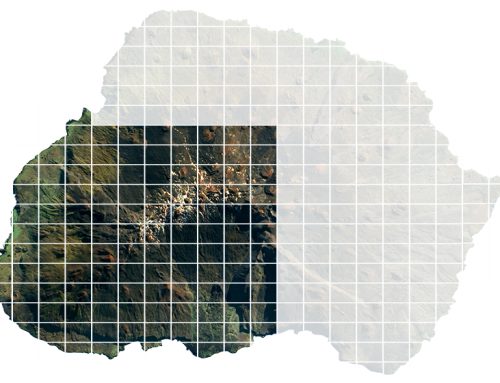
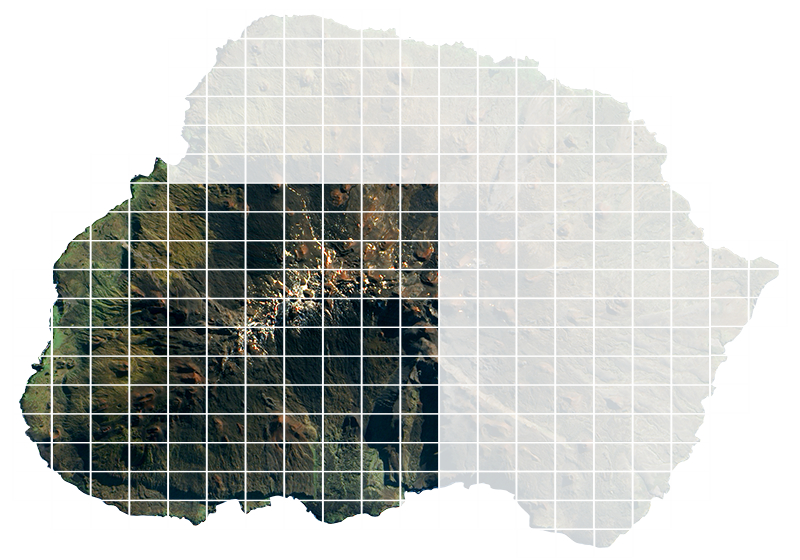
While waiting for our trial equipment and rodenticide bait to be flown ashore, Josh and Keith set off to the north to reconnoitre for a suitable site for a nine-hectare baiting trial. Once a site was found, behind Sealer’s Beach and just south of Long Ridge, the next few days were spent marking out a grid over the 300 x 300 metre trial site.

Above: The team walking to their study site. Mouse-free Prince Edward Island in the distance. Photograph: Keith Springer
The idea for this trial was to apply rodenticide bait over the nine hectares and then conduct intensive monitoring of mouse activity and bait uptake within a one-hectare area in the centre of the plot. A week after we arrived at Marion, our bait and equipment were flown ashore, enabling us to complete setting up the trial site with tracking tunnels and trail cameras. Following some practice at the hand-broadcasting bait technique conducted in the helicopter hangar (Monique won the ‘Most Elegant Technique Award’!), we planned to wait out some forecast bad weather, and then start the baiting of the trial site.
Although it was snowing the following morning, which did not bode well, we put our faith in the weather forecast for it to clear in the afternoon, and we set off for the trial site mid-morning. The weather forecast was correct, so soon after midday we lined ourselves up along the start of the grid, bait buckets in hand, and set off in unison, advancing to a new throwing point every 25 metres, and spreading 750 g of bait from each point.
Following the bait distribution, we visited the trial site each day for seven days. We changed inked cards in the previously set tracking tunnels daily (the cardboard cards contain an ink patch in the centre, so that animals running through the tunnel cross the ink patch and leave their prints on the farther side of the card), monitored how much bait was left in each of the 26 bait monitoring plots (each 20 m2) and assessed the condition of the remaining bait. Every second day, we changed the storage cards in the trail cameras.

Above: A Skua flies above Josh Kemp as he sets up a study site with trail cameras to monitor mouse activity. Photograph: Keith Springer

Right: Ink cards installed in tracking tunnels were also used to monitor mouse activity at the bait monitoring plots. Photograph: Keith Springer
The monitoring enabled us to assess the level of mouse activity after the bait was spread. Bait uptake was high on the first night and dropped rapidly thereafter, although mouse activity never dropped to zero throughout the course of the trial. We attributed this to mice coming in from outside the trial area boundary, although they had to cross at least 100 metres of baited ground to reach the core hectare. This is entirely feasible, because as mice died from consuming the toxic bait, their territories were available for exploitation by other mice from outside the trial area. Because death from the toxin can take several days, incoming mice are still able to travel across the landscape for a period of time.
To test whether all mice in the trial area were eating the bait, snap traps were set within the core hectare. Because the bait contained a biomarker that fluoresces under UV light, we were able to determine that all trapped mice had indeed been eating the bait.
After seven days of monitoring the trial plot, we rebaited the area. This time, we used a mixture of standard-sized pellets and a smaller bait designed specifically for mice. Our main interest here was to determine whether the small pellets (they are 5.5 mm in diameter, compared to 10 mm diameter for the standard bait) would retain their form in the wet, windy conditions experienced on Marion Island, and whether they would be more rapidly degraded by weathering and invertebrate activity.

Above: A rodenticide bait pellet among Marion Island’s vegetation. Photograph: Keith Springer

Above: The bait pellets are treated with a biomarker that fluoresces under UV light, this allows the team on the island to confirm that trapped mice had eaten bait. Photograph: Keith Springer
As with the first period, we visited the trial site daily, a trip that was about an hour’s walk from the base each way. The weather gave us constant variation – rain, hail showers, snowfalls, sunshine, rainbows and nearly always, the wind. We determined that the 5.5 mm bait pellets were not consumed rapidly by insects, and that although they became wet through sooner than did the larger standard pellets, they didn’t disintegrate under weathering conditions experienced over the seven days of monitoring. Seven days is expected to be a sufficient time period for foraging mice to encounter and consume bait, so knowing that most pellets largely maintained their integrity was useful to know, as very few eradication operations have used this particular product. These results warrant further testing of this bait pellet size, to see how they handle being spread through a bait bucket spinner slung beneath a helicopter. We saw no evidence of birds being interested in bait pellets.
After the second seven-day monitoring period, our time on the island was nearly up. We had hoped to conduct similar, but smaller trials at about 760 metres above sea level, in the polar desert habitat, but the delay in getting materials ashore meant that this wasn’t possible. A formal ceremony to hand over the running of the base and the science programmes from the outgoing team (M81) to the incoming team (M82) was held, and a couple of days later we were flown back to the ship, ready to commence the voyage back to Durban, our port of arrival.
Although we couldn’t complete our full work programme, we were able to establish a good start on implementing the trials outlined in the Research Plan. The results from the 2025 trials will inform the design for a larger, aerial-based trial that we want to undertake in 2027.
As well as conducting the trial throughout the relief period, team members also contributed to the resupply of field huts around the island, unloaded and sorted inbound and outbound cargo, undertook video monitoring of mouse attacks on albatross chicks at Grey-Headed Albatross Ridge and Monique inducted Von and Roelf into the work programme tasks they will undertake in the year ahead.
Keith Spinger, MFM Operations Manager, 23 July 2025
*****************************************************************

The study site on Marion Island. Photograph: Keith Springer
The Saving Marion Island’s Seabirds: The Mouse-Free Marion (MFM) Project is a registered non-profit company (No. 2020/922433/08) in South Africa, established to eradicate the invasive albatross-killing mice on Marion Island in the Southern Ocean. The project was initiated by BirdLife South Africa and the South African Department of Forestry, Fisheries and the Environment. Upon successful completion, the project will restore the critical breeding habitat of over two million seabirds, many globally threatened, and improve the island’s resilience to a warming climate. For more information or to support the project please visit mousefreemarion.org.