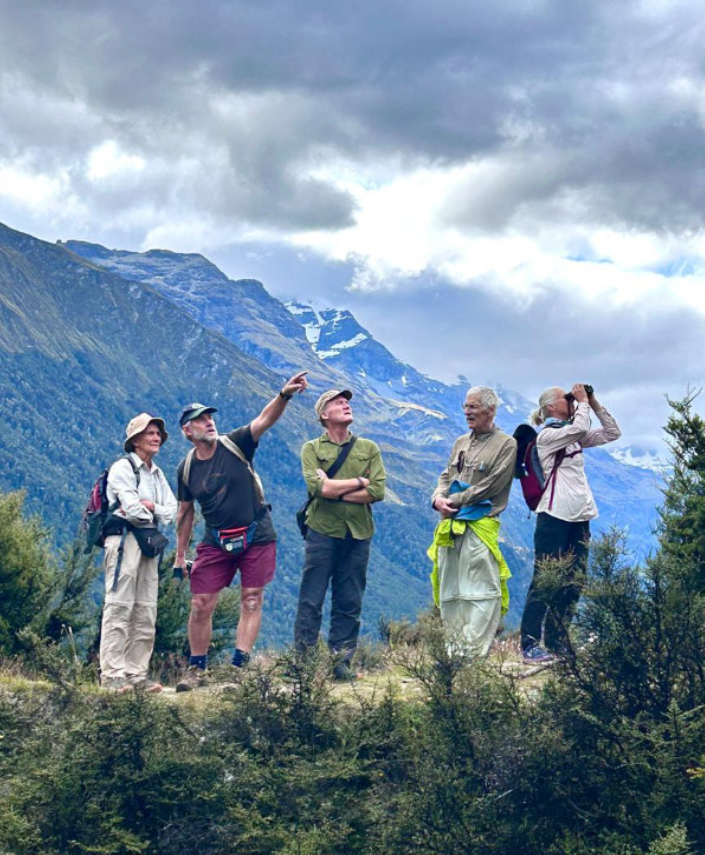
The MFM team and supporters taking in the sights of New Zealand on a stoat trapline survey along the Invincible Mine Track above Glenorchy. From left: Penny Preston, Keith Springer, Anton Wolfaardt, Guy Preston and Sue Tonin. Photograph by Leigh Wolfaardt
Restoration of the world’s marvellously diverse islands through removal of invasive predators is one of the most effective tools in conservation management today. Having grown from small beginnings in New Zealand, this method has grown significantly in scale and has been successfully used around the world. Hundreds of islands are now home to healthy bird, plant, and invertebrate communities after the eradication of invasive mammals. The application of this biodiversity conservation tool for Marion Island is under way, and at 30 000 ha it stands out as one of the largest rodent eradication operations planned to be conducted in a single attempt.
In February 2026, four members of the Saving Marion Island’s Seabirds: The Mouse-Free Marion (MFM) Project team travelled to Auckland, New Zealand, to participate in the fourth Island Invasives conference, which had the theme ‘Charting the Future’. Anton Wolfaardt (MFM Project Manager), Keith Springer (MFM Operations Manager), Sue Tonin (MFM Assistant Project Manager) and Guy Preston (MFM NPC Board member) joined a congress of more than 300 conservation professionals who are focused on saving island ecosystems from the effects of invasive species. From the appropriately diverse community of hands-on conservation professionals, conference delegates included practitioners, researchers, representatives of multiple levels of many governments, holders of indigenous knowledge, people with in-depth knowledge of financing, biosecurity experts, dog handlers, drone specialists and industry providers including bait and trap manufacturers. Delegates came from at least five continents, along with islanders from the Pacific, Indian and Atlantic Oceans, and the Caribbean.
Scale influences the complexity of island restoration operations, which require anticipation of, and planning for, uncertainties. To eradicate successfully an invasive predator as adaptable as the House Mouse, we must learn from past successes and failures. The success rate of rodent eradications since the 1990s is high, but it is essential that we learn critical lessons from two mouse eradications that have failed in the last five years: Gough Island in the South Atlantic and Sand Island, Midway Atoll, in the northern Pacific.
Before the start of the conference, two separate but complementary workshops took up the challenges of rodent eradication by focusing on rats, and on House Mice. The latter was convened and chaired by Keith Springer. Rodenticide bait composition was a topic of particular interest: specialised bait manufacturers are integrally involved in developments of eradication tools and were well represented at the conference. Choosing a bait pellet that smells and tastes good to mice, and is just the right size, is a research focus for several groups around the world, including the MFM Project on Marion Island. The project team has been conducting bait trials both on the island as well as in New Zealand in collaboration with the Department of Conservation.
During the four days of the conference, the MFM Project team heard various presentations on novel technologies for eradication of invasive species on islands. Several, although interesting, were not suitable for Marion Island. Most valuable were the discussions around the technical aspects of bait spreading and maximising the accuracy and evenness during aerial spreading from bait buckets. Flow rates from the buckets need to be carefully calibrated to achieve the required density of bait pellets on the ground. Sensors to measure this are currently being trialled and refined in New Zealand and results from recent trials of these new technologies were presented by the New Zealand Department of Conservation.
Exchange of ideas at the conference spanned all aspects of eradication projects designed for many groups of invaders: plants, amphibians, reptiles, mammals, arthropods, fish, birds, and pathogens. Presentations, including one by Anton Wolfaardt, the MFM Project Manager, spanned (but were not limited to) the implementation of best practise, iterative research tailored for the climate and habitat of individual islands, studies of ecology and behaviour, bait acceptance by, and availability to the relevant invasive species, and importantly, the importance of human social considerations. Knowledge capture and modes of information sharing are increasingly important as the field expands, aiming to communicate the results of each successive operation quickly to the wider community. Technical collaboration, and always, the management of risks, are consistent themes.
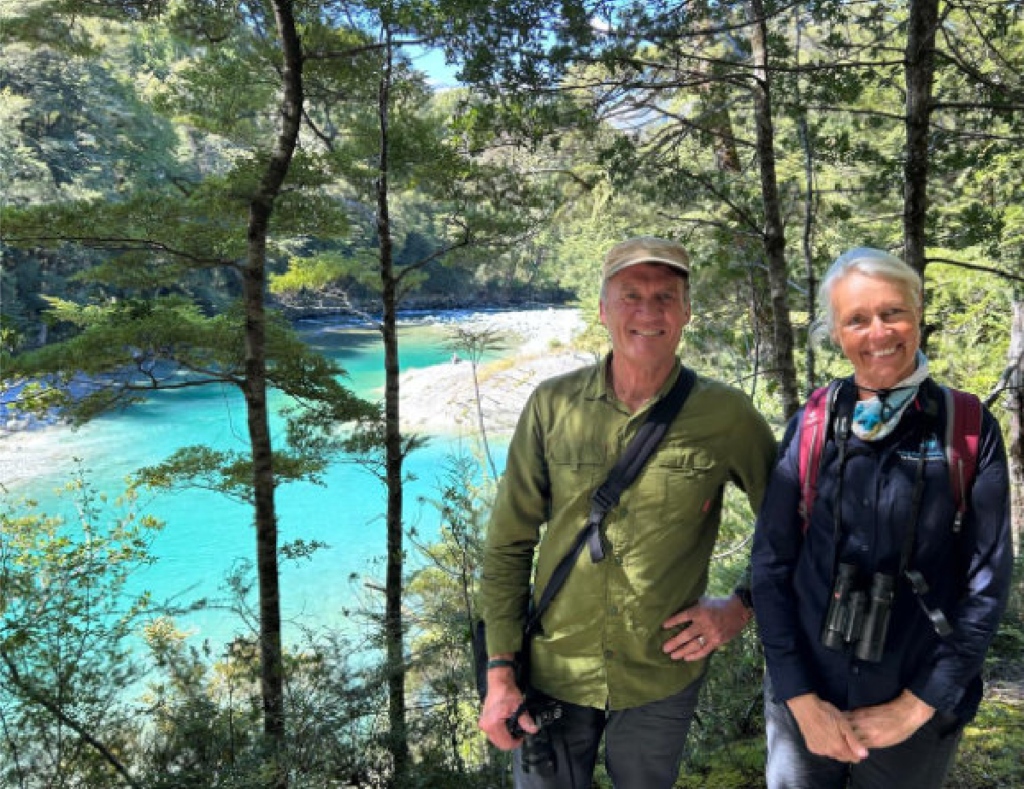
Post conference: Anton Wolfaardt and Sue Tonin on the Lake Sylvan Track within the Mount Aspiring National Park near Glenorchy, New Zealand, photograph by Leigh Wolfaardt
Field trips to locations that are predator-free or where current eradication projects are underway included Sanctuary Mountain Maungatautari, Rangitoto and Motutapu Islands and Waiheke Island. These gave conference delegates unforgettable demonstrations of the biodiversity gains achieved by invasive predator removal. These places echo with some of the most beautiful birdsong on the planet – the sound of New Zealand’s past and, for many islands and parts of the mainland, also its future, as predator control gains momentum.
Globally, restoration specialists are united by their understanding of how well and completely this methodology can work. Most of them have seen first-hand the rebounding and flourishing that follows removal of invasive predators introduced by humans to fragile island ecosystems. This knowledge fuels our determination to continue refining and using this conservation tool on an expanding number of islands to bring back their safe haven status, so necessary in the world’s threatened oceanic realm.
Read an earlier article about the conference in MFM News here. Abstracts for the oral presentations and titles of posters can be found here.
Sue Tonin, Assistant Project Manager, Keith Springer, Operations Manager & Anton Wolfaardt, Project Manager, Mouse-Free Marion Project, 12 May 2026
*****************************************************

The Mouse-Free Marion Project is a registered non-profit company (No. 2020/922433/08) in South Africa, established to eradicate the invasive albatross-killing mice on Marion Island in the Southern Ocean. The project was initiated by BirdLife South Africa and the South African Department of Forestry, Fisheries and the Environment. Upon successful completion, the project will restore the critical breeding habitat of over two million seabirds, many globally threatened, and improve the island’s resilience to a warming climate. For more information or to support the project please visit mousefreemarion.org