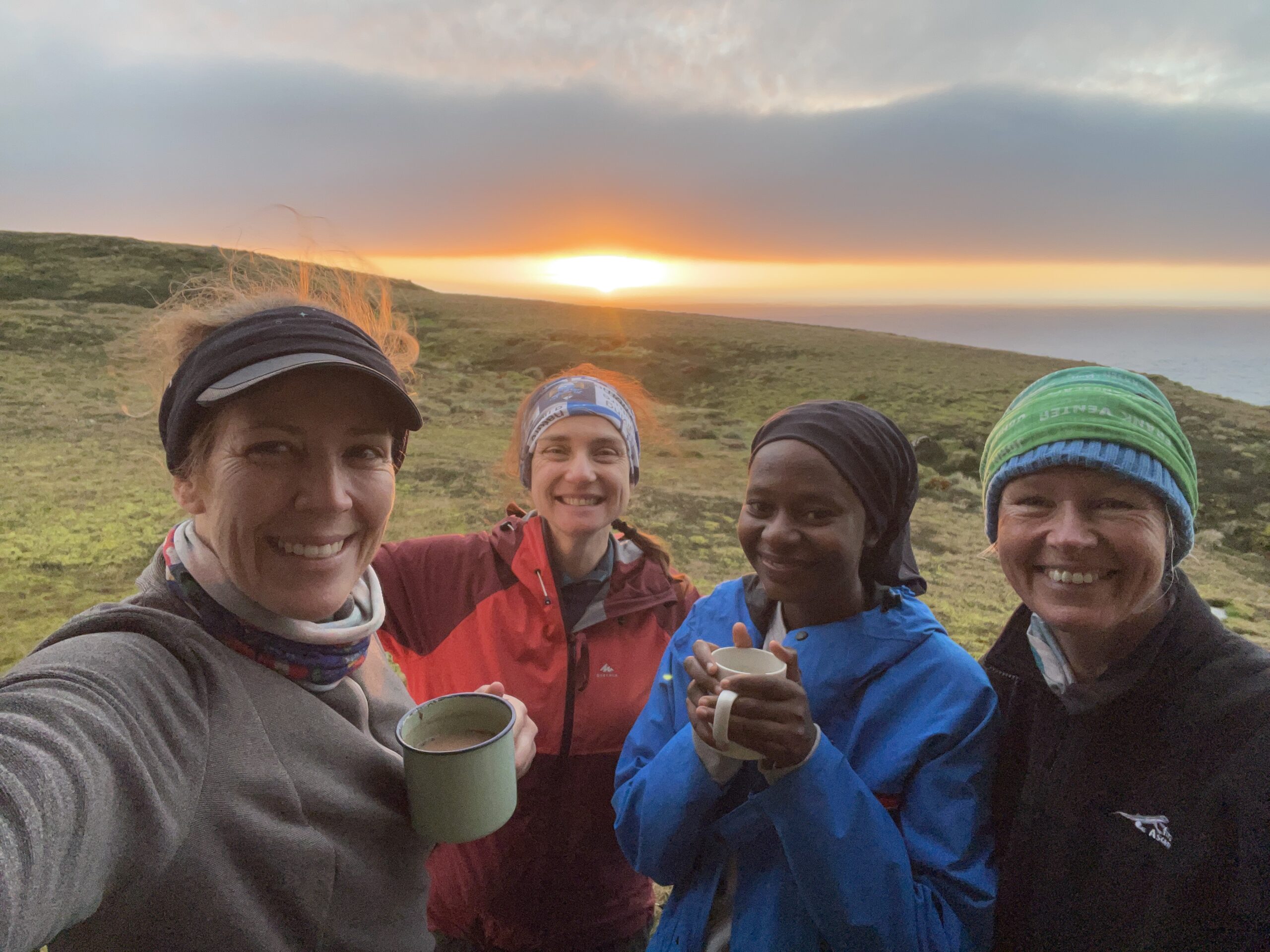
Above: Santjie du Toit, Vonica Perold, Lola Singo and Sue Tonin enjoy a rare sunset at Mixed Pickle Hut, photograph by Sanjie du Toit
This year’s relief voyage (takeover) to Marion Island was unusual, because the vessel arrived at an empty base. As many who read this newsletter will know, the previous overwintering team (M82) was evacuated from the island in May 2026, due to issues with polar diesel supply. The island’s wildlife and invasive House Mice then had the island to themselves for nearly twelve weeks.
The S.A.Agulhas II departed from a stormy Cape Town on 5 August with four Saving Marion Island’s Seabirds: The Mouse-Free Marion (MFM) Project team members on board. We were fortunate to be joined by Dr Vonica Perold: she and Roelf Daling were the MFM Project Field Assistants on the M82 (2025/26) Overwintering Team. Von’s guidance was essential for the handover to MFM’s new Field Assistants, Lola Singo and Santjie du Toit (see “Changing of the Guard”, April 2026). The fourth member of our team, Dr Sue Tonin (MFM Assistant Project Manager), last visited Marion Island in 1989 while completing her Ph.D. work on the albatrosses and penguins of the island.
We reached Marion Island on 9 August. The next day, a team from the Department of Forestry, Fisheries and the Environment (DFFE) and the Department of Public Works and Infrastructure (DPWI) was flown across to begin the demanding work of reactivating the base and configuring the new communications system. Fortunately, the base proved to be in good condition after its thorough shutdown in May. Nonetheless, recommissioning was hard work for the DPWI and DFFE. Restarting of the five generators was followed by work on the electrical infrastructure and routine building maintenance tasks.
Straight from the ship into the field
During the voyage south, it was confirmed that field research teams would be flown directly from the ship to the field huts scattered around the island. This happened on the second day after arrival at the island, so that hut restocking could be undertaken simultaneously with recommissioning of the base. This adaptation of the usual relief plan, in which personnel are first flown to the base, meant that many researchers did not need to wait on the ship before their takeover work could begin. It gave a welcome head start to the MFM Project’s programme, permitting early completion of round-island orientation, servicing of weather monitoring cameras, and scouting of suitable locations for a new mouse trapline on the western side of the island. Our walk around the island began at the hut at Rook’s Bay on the island’s southwest coast.
It was thrilling beyond words to start our takeover in the field, where we could feel the vegetation underfoot and smell its incomparable, mirey fragrance.
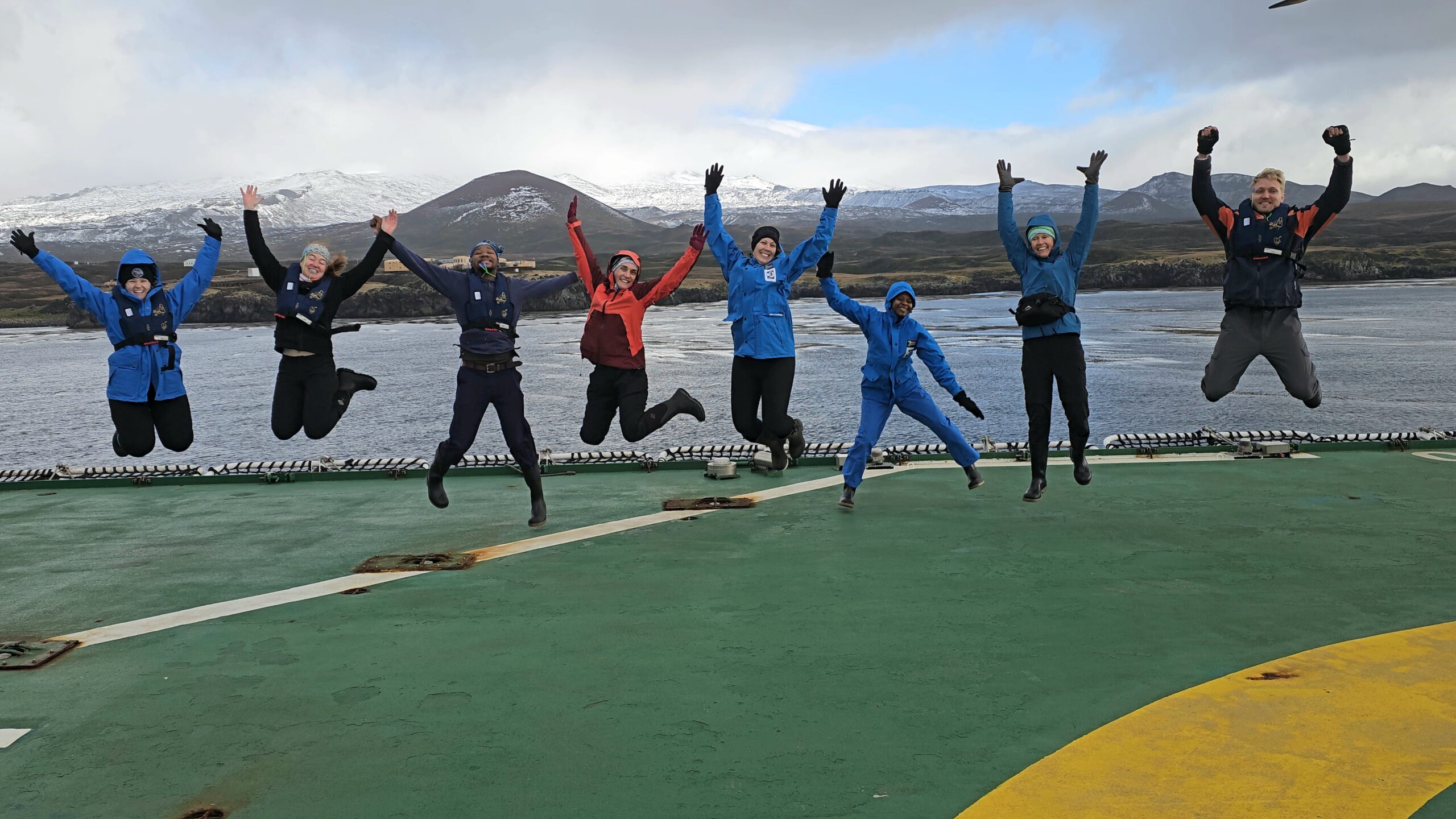
Hijinks: excited birders and mousers about to board Ultimate Heli’s Bell 412 helicopter, bound for Marion Island’s south coast. From left: Shani Fourie (South African Polar Research Infrastructure); Michelle Risi and Avumile Bawuli (FitzPatrick Institute of African Ornithology, FIAO); Von Perold, Santjie du Toit, Lola Singo and Sue Tonin (the MFM Project); and Chris Jones (FIAO). The base can be seen in the background, photograph by Rob Blakey
Soon after our arrival at Rook’s Hut, the Airbus H125 (“Squirrel”) helicopter brought us a load of new supplies for the coming season. We packed these into the hut pantry and cleared out expired food supplies.
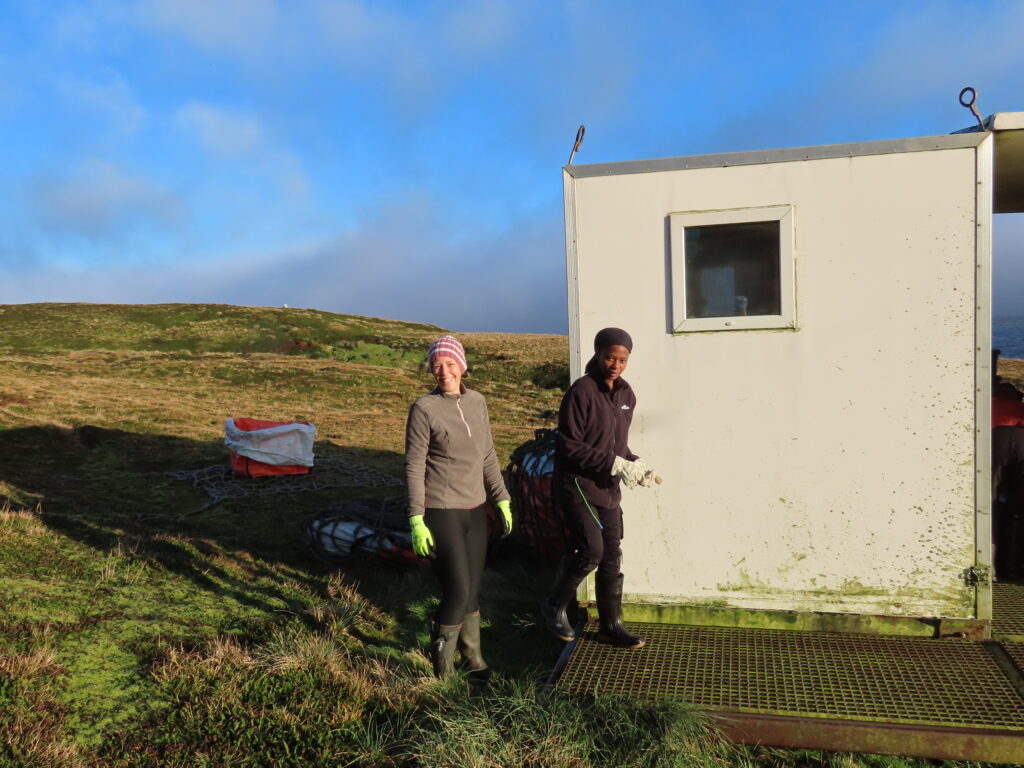
Santjie and Lola packing up old provisions to be returned to the ship during restocking of Mixed Pickle Cove Hut. With their complementary skills, tenacity, and positive “can-do” natures, the MFM Project could not have asked for two better field researchers. The white dot atop the rise on the horizon is a five-to-six-month-old Wandering Albatross chick, photograph by Sue Tonin
Recruited in late 2025, Santjie and Lola have been waiting since earlier this year to reach Marion Island. Earlier this year Lola graduated cum laude from Stellenbosch University with an M.Sc. in the evolution of mouse ectoparasites. Santjie is an experienced islander, weather specialist and island restoration practitioner who has spent a combined total of more than five years on Marion and Gough Islands, Midway Atoll in the Hawaiian Archipelago, and at the SANAE IV base in Antarctica. Earlier this year, we asked the new MFM Project Field Assistants what they were most looking forward to during their time on the island. During the takeover it became clear that Lola and Santjie are more determined than ever to make a meaningful contribution to the restoration of this remarkable island.
Assessing mouse abundance from coast to mountains
With our restocking work at Rook’s Hut complete, we began the c. 8-km trek to our next overnight stop: the hut near Swartkop Point on the western shore of the island. This coast is wildly beautiful and more exposed to the prevailing westerlies than the eastern side where the base is located. Still unweathered by the surging power of the great circumpolar swells, Marion’s western shore rises steeply from the Southern Ocean. The island was raised from the sea floor by volcanic activity less than 500 000 years ago. The great forces that shaped it are visible across the landscape as icy peaks, lava flows, scoria cones and dramatic cliffs.
The aim of the MFM Project’s work on this side of the island is to build on previous trapping transects that Von and Roelf conducted on the western side of the island in July 2025. During the 2026 takeover, we reconnoitred for a trapline site from near the Swartkop Hut into the mountainous interior, to continue assessments of mouse relative abundance along an altitude gradient. These will help confirm whether the quantities of pellets that we plan to spread are sufficient for every mouse on the island to encounter bait. The standardised trapping methodology we use permits seasonal and spatial comparisons of mouse abundance from the coast up to the polar desert.
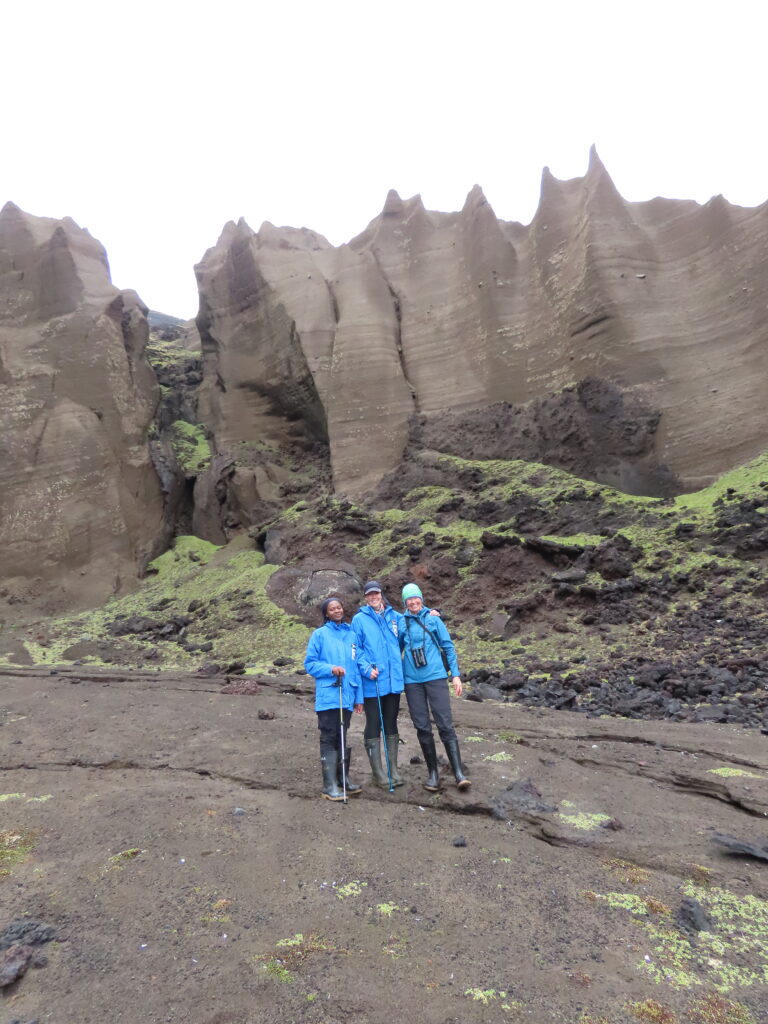
Lola, Santjie and Sue grinning with excitement at the site of a lava flow from 1980: “Batman’s Lair” at Kaalkoppie, north of Swartkop Point, photograph by Von Perold
Following an exploratory walk to the area around Wolfie and Truter peaks, and after much discussion, we decided on a location and layout for our new trapline. This needed to span from the coastal biotic zone between Swartkop Point and Kaalkoppie to the slopes of Truter Peak at 650 m, yet be sheltered enough for setting and checking of mousetraps – fiddly work in snow, fog and wind. Shelter is a relative term on Marion. The trapline is accessible from Swartkop Hut, which will be Santjie and Lola’s second home while they are busy with this work. Two weeks after the relief voyage, they set up and ran the first of a series of repeated transects.
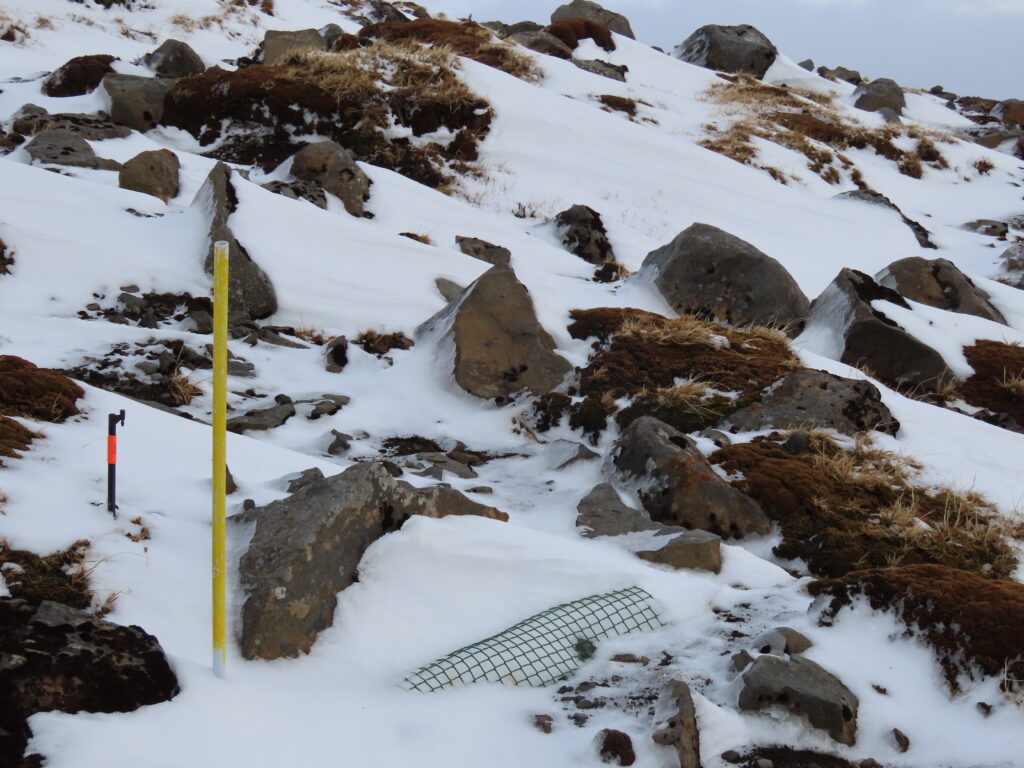
One of the challenges of winter is the heavy snowfall that often buries mousetraps. The green mesh visible above the snow is the top of the trap cover that prevents interference by inquisitive birds. It is secured with pegs or stones, with two traps set underneath each cover, photograph by Sue Tonin
Back at base: setting up bait pellet trials inside mouse exclosure cages
The specially formulated rodenticide bait we’re using comprises cylindrical compressed cereal pellets. One research topic we’re investigating is the weathering of these bait pellets after they’re spread. Two pellet sizes are currently under consideration: either 20-mm long (weighing 2 g), or 14 mm (1.4 g). To assess pellet weathering in the absence of mice, we use 1-m2 wire mesh cages embedded in the vegetation in coastal habitats where invertebrate density is high. This allows us to gauge the influence of two factors: weathering by rain or temperature changes (freeze/thaw), and nibbling – chiefly by slugs and tiny wingless invertebrates called springtails (Collembola).
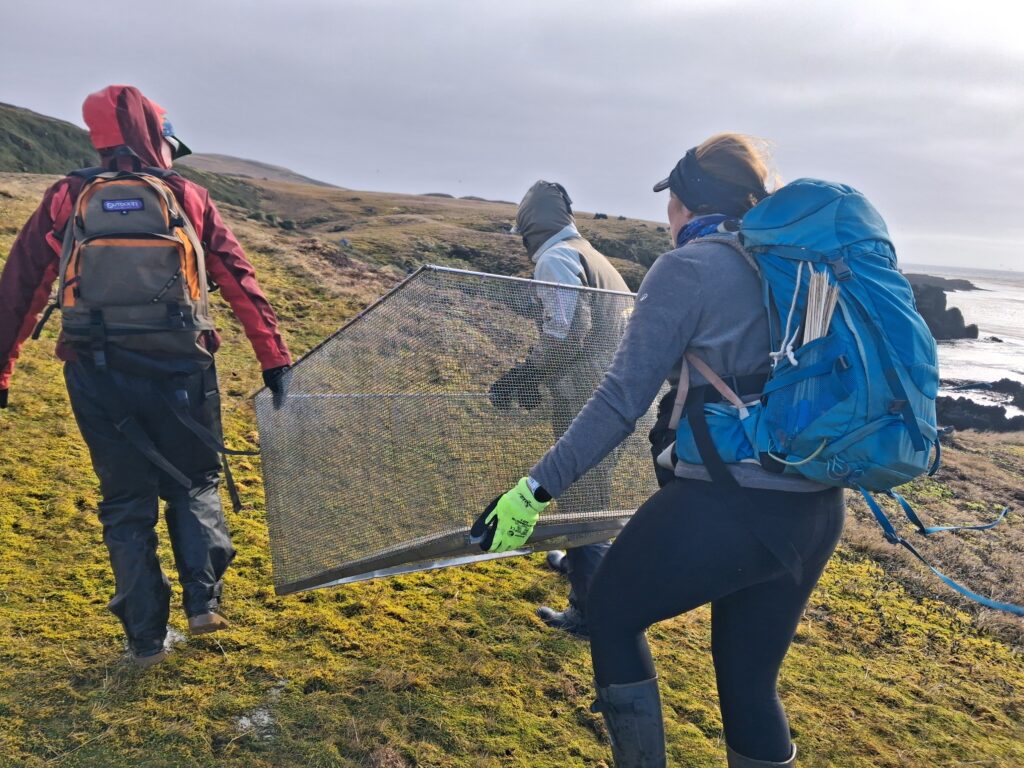
Relocation of an exclosure cage from the base to nearby Duiker’s Point, an area of high invertebrate density, photograph by Lola Singo
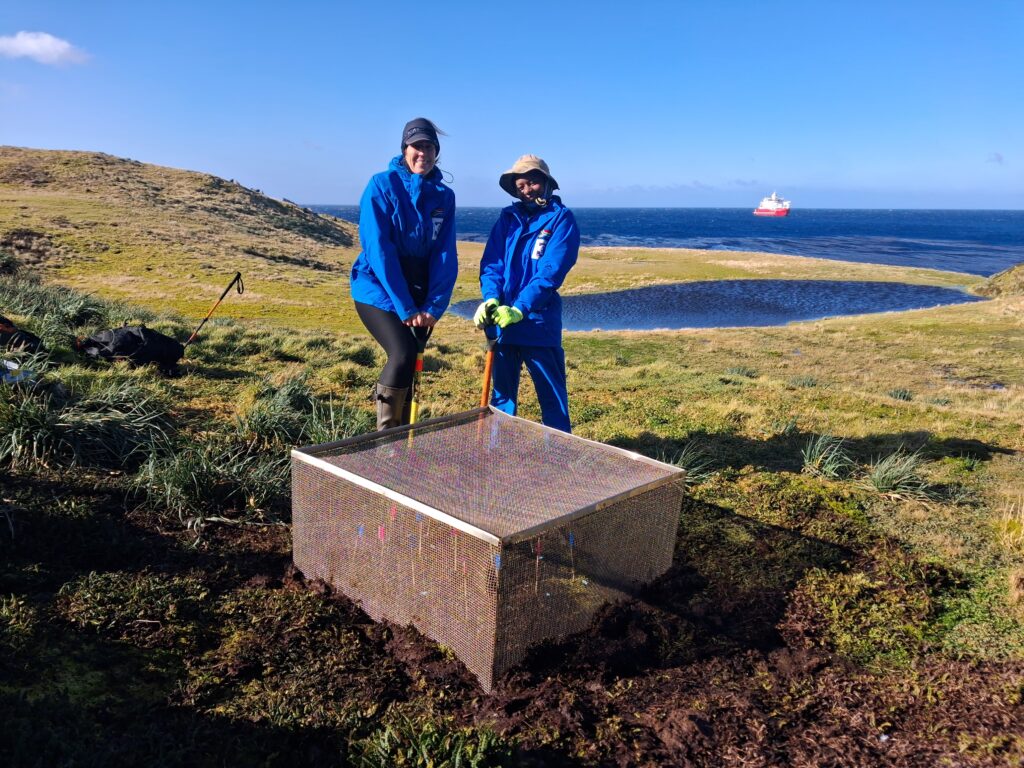
Duikers Point bait trials: flagged non-toxic bait pellets of two different sizes are visible inside this exclosure cage, with the S.A. Agulhas II offshore in the background. The cage prevents mice from accessing the bait, allowing us to assess pellet weathering and consumption by invertebrates¸ photograph by Sue Tonin
Preparations for 2027 Relief Voyage: monitoring work on the aerially baited plot
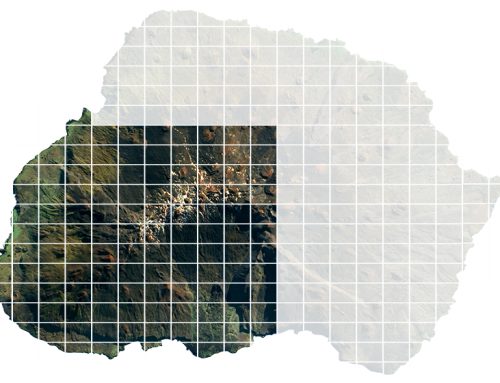
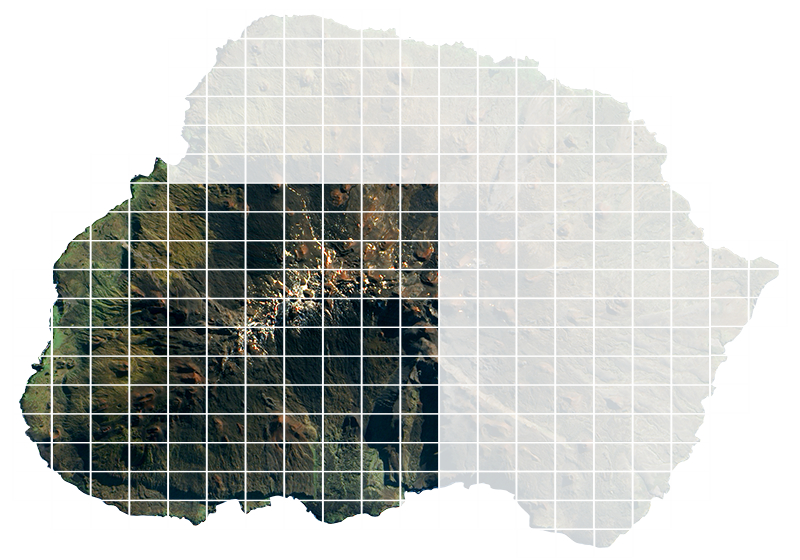
In the previous issue of this newsletter, Keith Springer and Robyn Adams described how the MFM Project team is working to refine our eradication strategy and tailor it to the conditions specific to Marion Island (see “Habitat Restoration”). This refinement is guided by a Research Plan that focuses on resolving uncertainties around conditions on Marion Island, using trials over a larger spatial scale than has our previous work. In 2027, we will apply bait twice by helicopter over a 1050-hectare plot. This will allow us to investigate how fast the mice remove bait once it has been spread, how long the pellets last once all mice in the central area of the plot are dead, and from how far away and how quickly mice reinvade the plot from unbaited areas outside its borders.
Much of Santjie and Lola’s work between now and March 2027 involves preparations for this trial. After each of the two bait applications, a team of monitoring staff will walk the plot daily, checking bait weathering and removal by mice and non-target species (scavenging birds and invertebrates). They will monitor mouse numbers and activity using trail cameras, snap traps, and tracking tunnels.
Thanks to teamwork, a short yet successful takeover
For ensuring that all our essential goals for this relief period were met, particular thanks are due to the DFFE’s Departmental Coordinating Officer, Daisy Kotsedi, and the on-island DPWI team led by Mahlatse Maja and Mlamli Gazi. Together with Zaid Watson, Willem Boshoff, Dave Hedding, and too many others to name, real teamwork resulted in a successful and rewarding base recommissioning. The Ultimate Heli team, led by Captains Stefan Smuts and Mike McDougall, flew enthusiastically, safely and with great skill under challenging conditions to make everything happen in good time.
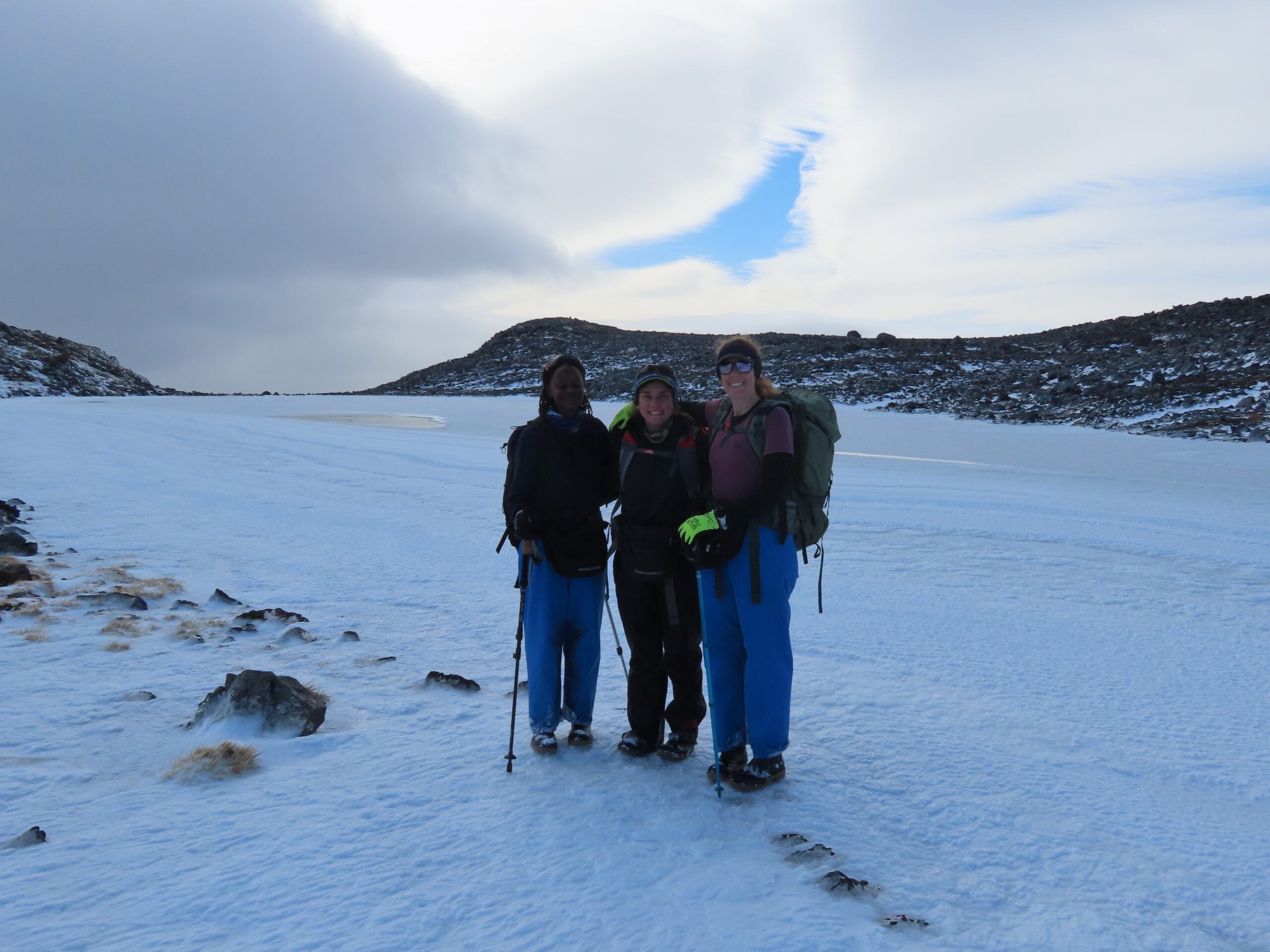
Frozen Lake Kopanong atop Long Ridge, from which we could overlook the site of the 2027 baiting trial, photograph by Sue Tonin
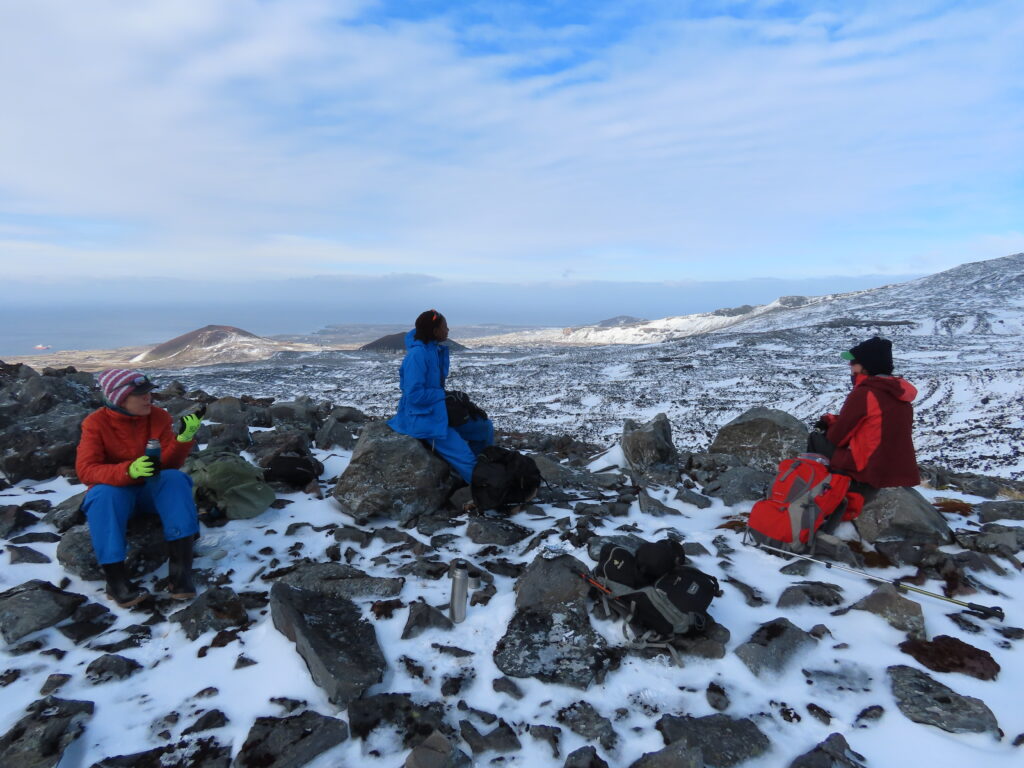
The team having lunch while overlooking the 1050-ha trial plot, photograph by Sue Tonin
Sue Tonin, Mouse-Free Marion Assistant Project Manager, 13 October 2026
***********************************************************************
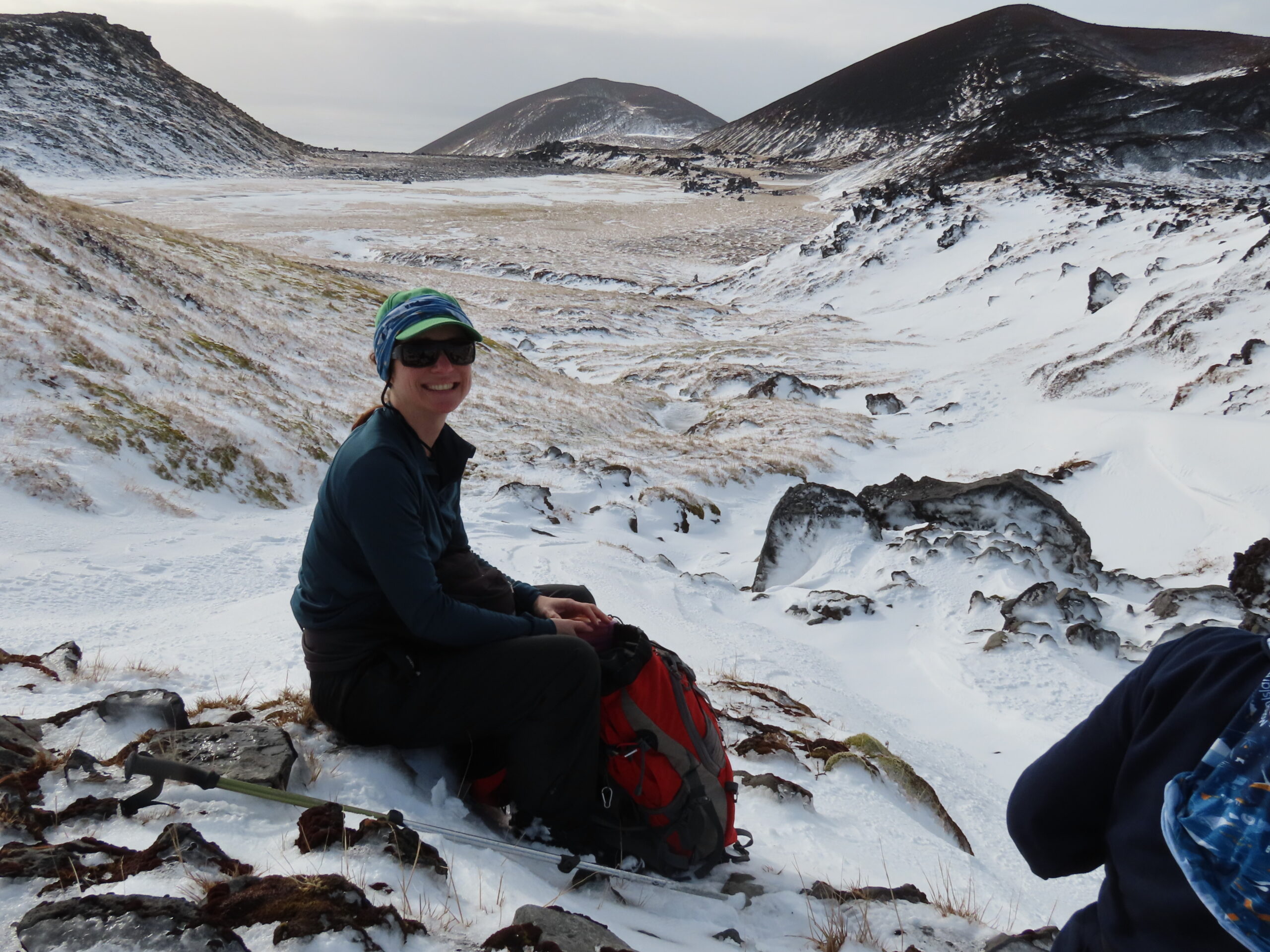
Von Perold enjoying a snack break on the path to the highest field hut at Katedraalkrans. She sits within the aerial baiting trial area, that’s planned for 2027. Hendrik Vister Kop is on the top right and Junior’s Kop in the centre background. The slopes of Tafelberg are to the left, photograph by Sue Tonin
The Mouse-Free Marion Project is a registered non-profit company (No. 2020/922433/08) in South Africa, established to eradicate the invasive albatross-killing mice on Marion Island in the Southern Ocean. The project was initiated by BirdLife South Africa and the South African Department of Forestry, Fisheries and the Environment. Upon successful completion, the project will restore the critical breeding habitat of over two million seabirds, many globally threatened, and improve the island’s resilience to a warming climate. For more information or to support the project please visit mousefreemarion.org.